Showing posts with label Musical. Show all posts

🎥 Review: The Blues Brothers (1980)


I want you to "shake a tailfeather" and do yourself a favor—if you haven't seen The Blues Brothers (1980), please do!

It took me a while to finally get around to watching it. I still have a LONG list of films to tackle, and some inevitably slip through the cracks. I'm so glad I finally crossed this one off my list because I had an absolute blast. It's bonkers!


I found myself laughing and saying out loud, "What the hell?!" multiple times during the film. 😂 Just when I thought it couldn't get any crazier, it somehow did. The best way to describe it is like a live-action cartoon—endless chaos, thrilling car chases, outrageous humor, and fantastic music from start to finish.


Directed by John Landis and co-written by Landis and Dan Aykroyd, 1980s classic boasts an incredible cast. Alongside Aykroyd and John Belushi, the film features Carrie Fisher and several memorable cameo appearances. It serves as a true love letter to blues music, showcasing legendary performances by Aretha Franklin, James Brown, Ray Charles, Cab Calloway, and John Lee Hooker.


The car chases are absolutely bonkers. The Blues Brothers set a Guinness World Record at the time by wrecking 103 cars. Every crash was done practically—no CGI, just a whole lot of flying American steel. In one memorable scene, they even dropped a Ford Pinto from 1,200 feet out of a helicopter!


And then there's the iconic shopping mall chase. The filmmakers found the abandoned Dixie Square Mall outside Chicago and decided to use it. They spent weeks restoring it with lights, electricity, storefronts, and real merchandise... only to demolish it all again with speeding police cars crashing through actual glass and real stores.


I love discovering hidden gems like this. It's one of the best parts of watching films. There are so many classic movies that don't always get the recognition they deserve, and then one comes along that's just pure joy from start to finish. If you haven't seen The Blues Brothers, be sure to add it to your watchlist. It's one of those films that you won't want to miss!


🎥 Review: Neptune's Daughter (1949)

 "I'd like to tell you a story about a guy, a girl, and a bathing suit"


Neptune's Daughter, a delightful technicolor musical romantic comedy film, is celebrating its 75th anniversary. It was released on this very day in 1949 by MGM. This colorful masterpiece stars the talented Esther Williams, Red Skelton, Ricardo Montalbán, Betty Garrett, Keenan Wynn, Xavier Cugat, Xavier Cugat, and Mel Blanc. Directed by Edward Buzzell, it introduced the Academy Award-winning song "Baby, It's Cold Outside" by Frank Loesser sung by the four main actors.
I found the film to be a fun and engaging watch, a perfect distraction for some entertainment. 


Plot: Swimmer-turned-entrepreneur Eve Barrett teams up with her pal Joe Backett to run a chic swimsuit business. When Eve's sister Betty starts swooning over a smooth South American polo player named Jose O'Rourke, Eve steps in to steer her away. Little does Eve know, that Betty is actually smitten with Jack Spratt, a masseuse pretending to be Jose. To shield her sister from heartache, Eve tracks down the real Jose and agrees to a date. But in a surprising twist, Eve ends up catching feelings too. 


The film requires you to overlook the absurd plot elements (such as someone confusing Skelton with a South American polo star) and just go along with it. I repeatedly watch the movie solely to admire the vibrant swimsuits and the beautiful wardrobe worn by Williams. Interestingly, this film is responsible for popularizing the timeless Christmas favorite, and Academy Award-winning song "Baby, It's Cold Outside" by Frank Loesser sung by the four main actors. Contrary to misguided beliefs, this song is not promoting date rape. I really enjoyed the way the song's lyrics were showcased in two different ways. In the first duet, Montalban and Williams, Montalban pursues Williams. On the other hand, in the duet between Garrett and Skelton, Garrett takes on the role of the pursuer while Skelton defends himself. The version with the main leads follows a more traditional and romantic approach, whereas the duet with the supporting leads is filled with humor.


Williams portrays a swimsuit designer in the movie and later drew inspiration from the swimwear designs featured in the film to create her own line of swimsuits.
When Williams was filming the movie, she was actually pregnant with her first child, so her swimming scenes are a bit calmer than you might expect. Instead, the "chorus" is the one doing all the cool sliding and diving stunts at the end, while Esther watches from a platform above, cheering them on.


Williams and Montalban, had co-starred in two movies together before this one: Fiesta (1947) and On An Island with You (1948). Williams had also collaborated with Red Skelton previously. He was her co-star in her first major film, Bathing Beauty (1944) (and had a small role in Duchess of Idaho, and starred alongside Williams in Texas Carnival (1951)). Williams had recently finished filming a movie with Garrett, Take Me Out to the Ball Game, which was released just two months before Neptune's Daughter.
 
Fun Fact: Mel Blanc provides the voice of Pancho with a high-pitched, exaggerated Mexican accent. He later reused this voice to create the beloved Warner Bros. cartoon character Speedy Gonzales after four years.

Easter Parade (1948)

“Fred put me completely at ease. He’s a gentleman – and lots of fun to work with.”- Garland on Astaire

"She wasn’t primarily a dancer, but she could do what you asked her to do. And she had great charm, and she was a very big star. She was in good form – we had a very good time. Our numbers together remain as high spots of enjoyment in my career. Her uncanny knowledge of showmanship impressed me more than ever as I worked with her.”- Astaire on Garland 


Back in 1948, MGM came out with a fun, colorful musical film called Easter Parade. One of my favorite musicals, I've watch it every Easter since I was little. The film was shot in ten weeks in order to be released in time for Easter. Originally, they had planned to have Gene Kelly play the role of Don Hewes, alongside Cyd Charisse and Frank Sinatra. However, due to Kelly breaking his ankle and Charisse's torn ligament, the cast ended up getting completely switched around. In the end, we get to watch a couple of swells, Fred Astaire & Judy Garland mesh so beautifully, a fast-tapping Ann Miller as Nadine, and the boyish debonair Peter Lawford rounding out the cast as Jonathan. 
 
 
Film Synopsis: Set in New York, in 1912, about a successful Broadway dancer named Don Hewes (played by Fred Astaire). When his current dance partner, Nadine Hale (played by Ann Miller), decides to leave him for a Ziegfeld production, Don is pretty angry. But he's convinced he can work with anyone and turn her into amazing dancer. Enter Hannah Brown (played by Judy Garland), a cheap diner performer who doesn't have much dance experience. But with Don's guidance and training, they become a huge sensation on stage and also fall in love. It's such a heartwarming and entertaining film - you'll love it! 


Trivia: Garland's husband Vincente Minnelli was originally slated to direct, but Garland's psychiatrist advised them not to work together. She had just been released from a sanitarium where she was treated for mental distress and drug dependency. Due to his two-year absence from the screen, Astaire wasn't sure if he could return. But after getting in shape and being reassured by Gene Kelly, he took the part. Garland had never met Astaire before and was afraid to speak to him until they were properly introduced. The shedding feathered gown worn by Garland in one number is an in-joke reference to Ginger Rogers' problematic gown in Top Hat (1935). A Garland solo number, "Mr. Monotony", was cut from the film.
 

'A couple of swells'


Keep your eyes peeled for Jules Munshin's funny scene in which he plays a waiter making an elaborate salad. You might think it's just for laughs, but it was actually part of MGM's clever way of screen testing out how audiences would react to him on screen. 
 
“I was pleased to be responsible for getting Fred back to work, but every time I see him and Judy singing A Couple of Swells, I do get a twinge of regret.”- Gene Kelly 
 
 
Fred Astaire, Peter Lawford & Judy Garland


Did you know that Ann Miller had to dance through the pain of pinched nerves in her back? She even had to wear a back brace during her delightful performance "Shakin' the Blues Away". In a candid interview with Robert Osborne, she also opened up about the abuse she suffered at the hands of her ex-husband Reese Milner. While pregnant and in agony, Ann was thrown down the stairs. She was also taller than Astaire, so she wore ballet slippers instead of heels so that they could be better matched during their dance routines. 
 
Ann Miller is 'Shakin the Blues Away
 
More than half of the songs performed in the Easter Parade were written by Berlin in the four decades prior to the film, and many of the songs were performed in various stage and film musicals. The songs that Berlin wrote especially for Easter Parade were: "It Only Happens When I Dance with You," "Better Luck Next Time," "Drum Crazy," "Stepping Out with My Baby," "A Couple of Swells," "A Fella With An Umbrella" and "Happy Easter." Another song, "Mr. Monotony," which was also written especially for the film, was not used. Berlin wrote the melody for the film's title song in 1917 and originally used it for a song entitled "Smile and Show Your Dimple." The song "Easter Parade" grew out of Berlin's reworking of "Smile and Show Your Dimple" for the 1933 revue As Thousands Cheer.
 
 
Irving Berlin (piano) Fred Astaire, Ann Miller and Peter Lawford 


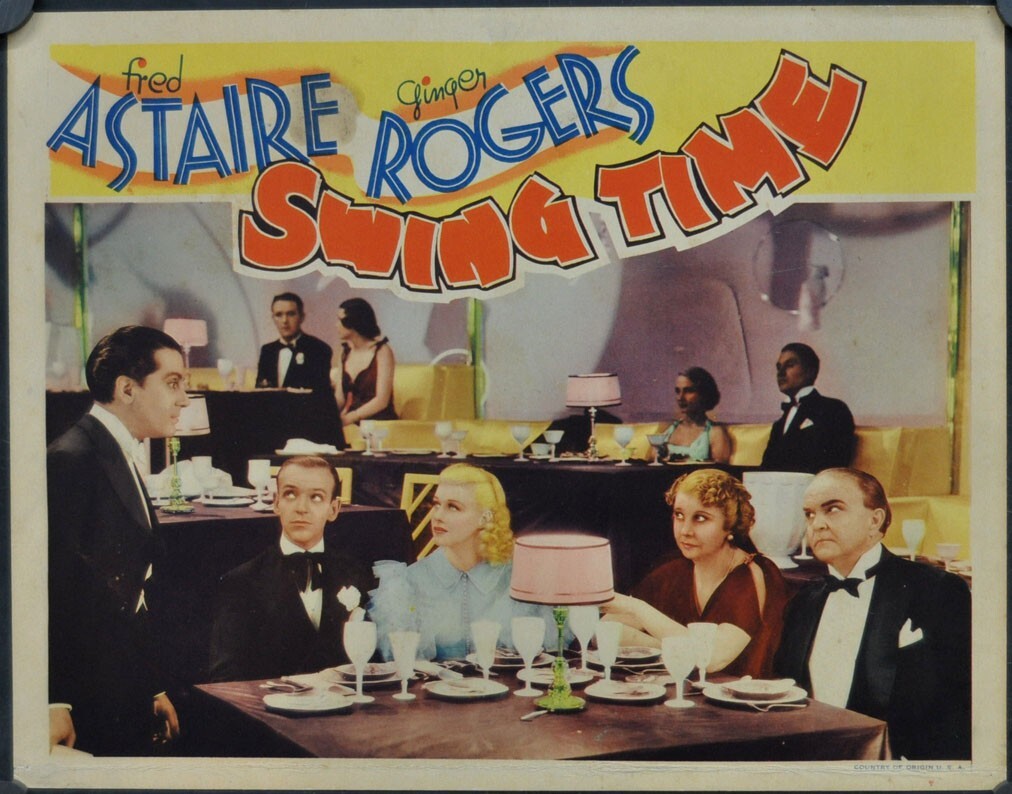
It was MGM's top-grossing picture of the year, taking in about $6,800,000 at the box office in its initial release. Easter Parade marked the first and final time Fred Astaire would work with Judy Garland. They were supposed to star in The Barkley's of Broadway together the next year, but unfortunately, Judy fell ill and the production plans got canceled. Fred wrote in his autobiography that the studio wanted to wait and see if she would make a quick recovery, but unfortunately, that never happened. He was deeply disappointed that Judy couldn't join the production, but he was also grateful when he found out that Ginger Rogers would be his new co-star. 


Directed by Charles Walter. Story by Frances Goodrich Albert Hackett. The script was revised by Sidney Sheldon, a young writer who would later make his name as one of the most successful crime novelists of all time. Roger Edens and Johnny Green took home the statuette for “Best Musical Score.”

The Broadway Melody (1929)


MGM's first all-talking picture, and the first sound film to win the Best Picture, Oscar. The first musical to use playback of the musical soundtrack during filming and to be conceived and written specifically for the screen. 


The top-grossing film of 1929 starred Charles King, Anita Page, and the lovely Bessie Love who was deserving of a nomination for the Best Actress  Academy Award. A pair of sisters from the vaudeville circuit try to make it big time on Broadway, but matters of the heart complicate the attempt. 

It was written by Norman Houston and James Gleason from a story by Edmund Goulding, and directed by Harry Beaumont. Original music was written by Arthur Freed and Nacio Herb Brown, including the popular hit "You Were Meant for Me". The George M. Cohan classic "Give My Regards to Broadway" is used under the opening establishing shots of New York City, its film debut.


The remake, Two Girls on Broadway (1940) starred George Murphy, Lana Turner, and Joan Blondell.The sequels all bore the title of the original. Also, the first musical to spawn three more sequels.