Showing posts with label 1970s. Show all posts

😱DISAS-TOBER! 🎥 REVIEW: The Towering Inferno (1974)

The disaster trend of the 1970s peaked with The Towering Inferno!


The movie boasted a star-studded cast, cutting-edge special effects, and jaw-dropping stunts. It not only garnered a coveted Best Picture nomination at the Academy Awards, but also ruled the box office in 1974.


Paul Newman and Steve McQueen headline the impressive ensemble cast, each earning a lucrative $1 million for their roles in the film.

Architect Doug Roberts, portrayed by Newman, returns to San Francisco for the unveiling of his architectural masterpiece, The Glass Tower, an impressive structure constructed by builder James Duncan, played by William Holden.


However, things take a disastrous turn when a fire breaks out during the celebration, putting everyone on the upper floors in danger. This chaos is likely due to Duncan’s son-in-law played ruthlessly by Richard Chamberlain, who has been cutting corners. 


Chief Michael O’Hallorhan, played by Steve McQueen, rushes to put out the flames and save those trapped inside, while Newman bravely navigates through the blaze to rescue as many people as possible. Meanwhile, guests are frantically trying to escape using stairwells, elevators, and even helicopters. The atmosphere is filled with tension. The impressive cast also features Faye Dunaway, Fred Astaire, Susan Blakely, Jennifer Jones, OJ Simpson, Robert Vaughn, Robert Wagner, and Susan Flannery.


Inferno is famous for the behind-the-scenes rivalry between two Hollywood icons. To ensure that both Steve McQueen and Paul Newman received equal recognition, the credits were arranged diagonally. McQueen appeared on the lower left, while Newman was on the upper right. This layout allowed each actor to seem like they were at the top, depending on how you read the credits. This was the first time this clever "staggered but equal" billing method was used in a film. The competition got intense, with McQueen even counting Newman's lines to demand equal treatment. Interestingly, McQueen's character doesn't show up until an hour into the movie!


Another intriguing point is that McQueen was originally offered the architect role in the film but opted for the Fire Chief part instead. Even though it was a smaller role, McQueen's push for equal lines, screen time, and pay with Newman added an exciting element to the film. Newman, who faced challenges on set, still managed to create engaging tension that enhanced the story.


John Williams composed the music for the film, which was a collaboration between two major figures in Hollywood: producer Irwin Allen and director John Guillermin. Allen was well-known for his disaster movies and had achieved success with films like The Poseidon Adventure. He crafted the exciting, action-packed scenes while Guillermin expertly crafted the suspense, delivering some thrilling and intense moments. For instance, there's McQueen's desperate effort to save a group of people stuck in an elevator, and Newman who did his own stunts bravely attempts to help Jones and some kids who are trapped by a fallen stairwell. 


Then there's Wagner's hopeless struggle to escape while Flannery is stuck in a suite that's on fire. 


Plus, there's a dramatic rescue attempt from a helicopter that ends with explosive consequences.


Overall, it's really impressive stuff. Some of the subplots feel reminiscent of a lighthearted Love Boat episode, which was typical of disaster films from that era, adding a nostalgic and slightly campy layer that somehow works in its favor, making the film even more enjoyable and entertaining. 


One storyline that always resonates with me is Astaire's role as a conman seeking love from Jones. While it may come off as a bit silly, Astaire delivers a solid performance, earning him an Oscar nomination—the only one he received throughout his illustrious career!


The Towering Inferno was a major success at the box office in 1974, receiving eight nominations for the Oscars, with Best Picture being one of them. In the end, it took home three Academy Awards for Best Cinematography, Best Film Editing, and Best Original Song for "We May Never Love Like This Again," which was written by Al Kasha and Joel Hirschhorn.


😱DISAS-TOBER! 🎥 REVIEW: The Poseidon Adventure (1972)

Get ready to face a different kind of scare this October - disaster films!

Many people find themselves feeling a bit uneasy when it comes to disaster movies, and it's understandable why. These films can be quite brutal, often touching on themes of mass death. But at the same time, there's something strangely captivating about them, much like horror movies. While there may be some cliched messages tucked away in there, the way the stories unfold can be pretty wild and unpredictable, particularly when it comes to the fates of the characters. In the end, these movies usually morph into simple adventure tales about regular folks just trying to survive in the face of overwhelming adversity. So let's get started with a film I try to watch every New Year's Day. 


"There's got to be a morning after"...

Attention passengers and crew of the SS Poseidon! Imagine yourself on the brink of a disaster, trapped inside an overturned luxury liner, with only a small group of survivors led by a preacher standing between you and safety. This is the harrowing situation on the SS Poseidon as it embarks on its final voyage from New York City to Athens before being scrapped. But as fate would have it, a tsunami strikes on New Year's Day, leaving you upside down and fighting for survival.


Now is the time to come together, follow the guidance of this preacher, and make a united effort to find a way out of this dire situation. Your lives depend on your ability to work as a team, to trust in the leadership of this preacher, and to never lose hope.


Get ready for the ultimate disaster movie adventure brought to you by 20th Century Fox and the legendary Master of Disaster, Irwin Allen! Featuring an all-star cast including five Oscar winners (Gene Hackman, Ernest Borgnine, Shelley Winters, Jack Albertson, and Red Buttons) head the cast, along with a mix of familiar faces (Stella Stevens, Leslie Nielsen, Carol Lynley, Arthur O’Connell, and Roddy McDowall) and young newcomers (Pamela Sue Martin and Eric Shea). 


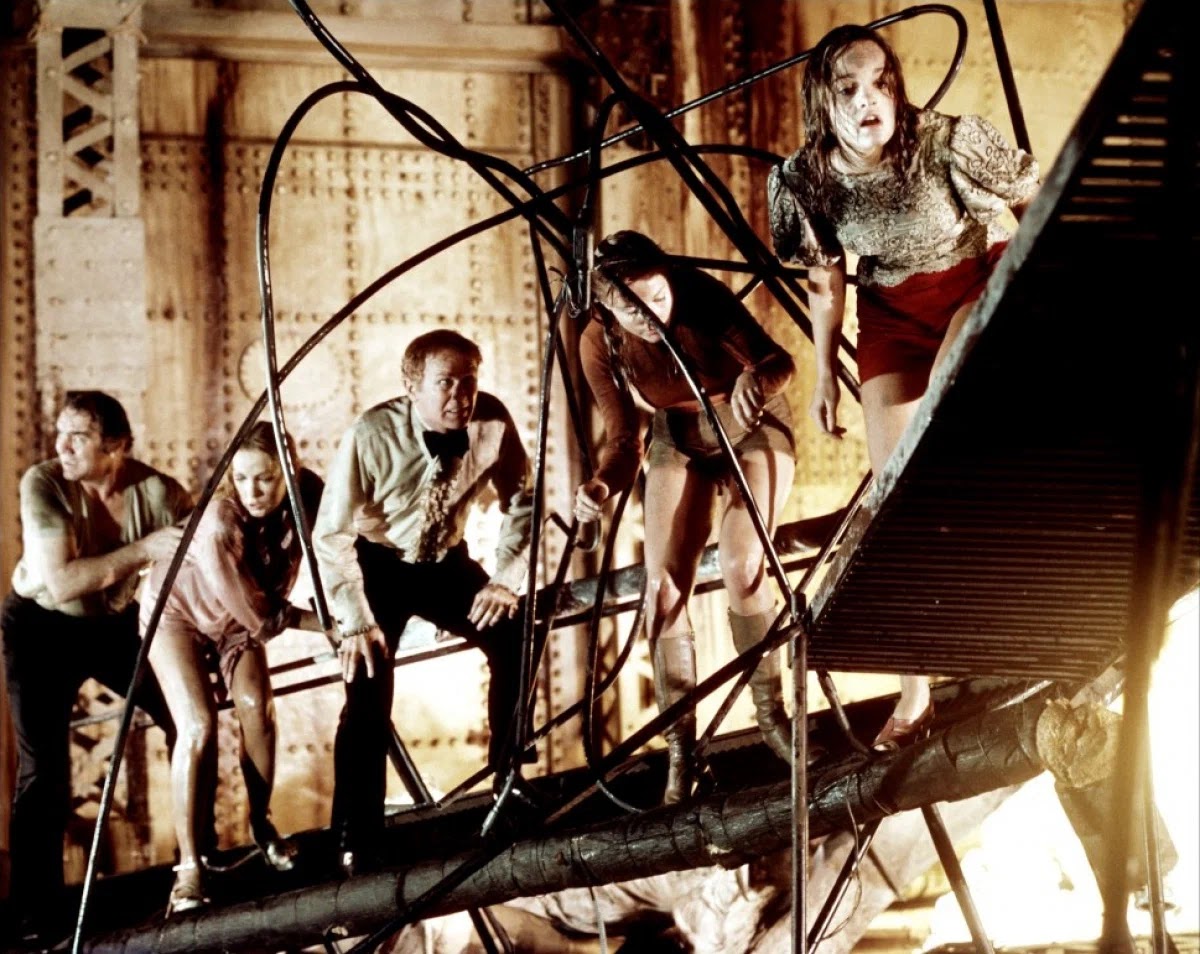
The cast and crew maneuvered through flames, traversed ductwork and shafts, climbed inverted ladders and staircases, navigated twisted metal, and waded through abundant pools of water as they documented their trek toward the hull, the sole section of Poseidon still visible above the surface. 


Director Ronald Neame filmed in chronological order, allowing the characters’ increasingly soiled faces, battered bodies, and ragged clothing to mirror the actors' real-life challenges. The film has always captivated my attention from start to finish. It's a rare gem in the world of disaster films, one that truly stands the test of time. Despite its imperfections, I can see why it's still an entertaining film. From over-the-top acting, the funny lines, and the sermons amid a visually thrilling experience that is both frightening and emotionally impactful.


The movie was a huge hit, and second grossing film of that year making over $125 million globally. It was up for eight Academy Awards and managed to snag two Oscars (Song and Visual Effects), a Golden Globe, a British Academy Film Award, and a Motion Picture Sound Editors Award.


Cool facts:
  • Esther Williams was initially offered the role that eventually went to Shelley Winters, as her swimming abilities made her a natural fit for the part. However, her husband Fernando Lamas, who had a strong influence over her career decisions, did not want her to appear on screen in a less-than-flattering way. Esther was disappointed that she did not end up making the film.
 
  • Many took on their own stunts and began to push themselves to outperform each other including the two-time Oscar winner Winters, who, at 51, added 35 pounds to authentically portray a former swimming champion swimmer and grandmother. She was never able to lose the weight after that. Actor Ernest Borgnine shared that there was a palpable sense of eagerness before they embarked on executing the daring stunts.
 
  • The passenger (Ernie Orsatti) who fell into a ceiling light fixture after the luxury liner was overturned by a tidal wave was paid $100 for the stunt and go it in one take. This led to him becoming a stuntman and coordinator. 
 

  • This was based on a novel by Paul Gallico from 1969. Gallico, started his career writing for magazines like The Saturday Evening Post in the 1930s and '40s. He got some of his story ideas from a tale shared by a crew member on the Queen Mary, which almost flipped over due to a massive rogue wave during its time as a troop ship in World War II. Interestingly, the film's opening scenes were filmed on the Queen Mary right after it was turned into a floating hotel in Long Beach, California.
 
  • Red Buttons and Carol Lynley had a strong dislike for each other while shooting. They avoided any interaction outside of their scenes together. Interestingly, despite this tension, they eventually formed a close friendship in the years that followed.
 
  • Married couple aboard the ship Ernest Borgnine and Shelley Winters ended up playing a married couple on an episode of The Love Boat in 1982. 


Los Angeles Times Photographic Collection at the UCLA Library.  
 
 
Academy Award winner Gene Hackman cuts cake on set of his new film, The Poseidon Adventure, at 20th Century Fox. Other members of cast who previously had won Oscars join in celebration. From left are Jack Albertson, Red Buttons, Ronald Neame (director), Hackman, Shelley Winters and Ernest Borgnine. Hackman won an Oscar for role as a tough detective in The French Connection.


🎥 Review: The Velvet Vampire (1971)

 “ever since that night at the gallery, ever since—I knew I wanted you. I was hungry for you as long as I could have you.”


Stephanie Rothman's 1971 film, The Velvet Vampire, isn't your average fang-tastic flick. Rothman co-wrote and directed a pioneering film that embodies the creativity and ingenuity of a female director in a largely male-dominated genre. With its unique take on the queer seductress vampire subgenre, Rothman shatters the conventional mold of passive female victims and instead elevates a strong and empowered female character to the forefront of the horror narrative. By standing out from the crowd and daring to tell a fresh and exciting story from a female perspective. 


Diane LeFanu, portrayed by Celeste Yarnall, is a cultured and affluent individual with a profound appreciation for art and music. She takes a keen interest in the striking married duo, Lee (Michael Blodgett) and Susan (Sherry Miles) and cordially invite them to her desert retreat for an indulgent weekend. However, Diane hesitates to disclose her true identity as an age-old vampire who still mourns the loss of her husband, centuries past, and feeds on the unsuspecting intruders wandering on her property. As Lee and Susan become aware of their genial host's vampiric nature, they may become her next victims. The film pays homage to J. Sheridan Le Fanu's illustrious work, Carmilla (1872), by naming the vampire character Diane Le Fanu, who happens to be the first lesbian vampire protagonist and served as the inspiration for The Vampire Lovers.
 

While it did have a slow pace, it was totally worth it for its dreamy Technicolor eroticism and campy psychedelic trip. What I found particularly interesting was the setting of the film. Instead of your typical gothic castle or spooky woods, our vampire protagonist, Diane, resides in a modern mansion in the middle of the California desert.  


I love Diane's fascinating wardrobe.  She's always covered from head to toe to avoid the sun, so we get to see her in a variety of stylish sun hats and capes. And her clothing is just stunning - passionate reds when seducing men, and stiff yellows or whites when approaching women.  It's an interesting choice that really adds to her character development. Now, I should mention that the script was written in just three months, but the director added some comedic elements to make it stand out from similar movies. The story may be simple, but the execution is imaginative and just plain beautiful.


Celeste Yarnall previously had substantial cameos in Live a Little Love a Little with Elvis Presley and Bob and Carol and Ted and Alice before being cast as the alluring, conflicted Diane.  
 
 
Yarnall is simply delightful in this movie- she exudes chill confidence and has an alluring gaze that just draws you in! Watching her is a lot of fun. Unfortunately, Blodgett and Miles, appear quite flat, passive, stilted, and dopey. We do get to see a lot of him and the female leads get quite a bit of screen time in the nude.
 
Michael Blodgett played a bevy of charming cads in Beyond the Valley of the Dolls, The Carey Treatment, then switched to screenwriting in the ‘80s, co-scripting Rent-A-Cop, Hero and the Terror, and Turner & Hooch. Sherry Miles was a regular cast member in Hee Haw, known for her roles in Mod Squad, The Beverly Hillbillies, Love, American Style, and The Partridge Family. Sherry Miles was a regular cast member in Hee Haw, known for her roles in Mod Squad, The Beverly Hillbillies, Love, American Style, and The Partridge Family.


Rothman was the first woman to receive a DGA fellowship during her studies at the University of Southern California and one of the first woman directors to work for a US studio. This led to a long working relationship with producer Roger Corman. She did everything learned in film school: write new scenes, scout locations, cast actors, direct new sequences and edit final cuts. Among the film were Beach Ball (1965), Voyage to the Prehistoric Planet (1965), and Queen of Blood (1966). She directed sections of Blood Bath (1966), followed by It’s a Bikini World (1970) and The Student Nurses (1970).  The Velvet Vampire, also made under the aegis of Corman’s New World Pictures, was a modest hit for her.  Rothman: "One of my greatest pleasures, determining how my style of shooting could enhance the content of a scene." 


After teaming up with her husband Charles Swartz, Rothman helped establish Dimension Films in 1971. The company gained notoriety for producing a number of exploitation films. During her stint with Dimension, Rothman directed Group Marriage (1973), Terminal Island (1973), and The Working Girls (1974), in addition to writing Beyond Atlantis (1973). However, she and Swartz parted ways with the company in 1975. Rothman then attempted to venture into non-exploitation films, but unfortunately found it difficult.

The Velvet Vampire has become a cult classic over time, with some theaters even booking it as an art film. However, its distribution was never consistent, as people reacted differently to it and it was produced independently. It also had to compete with other vampire movies that starred big-name actors. Despite these challenges, it's still enjoyed a dedicated following and can often be found at various festivals and retrospectives.

The film was released during a time when there was a lot of feminist activism happening, especially around issues like work, sex, and family. Her unique approach to the subject matter is a testament to her talent and how much of a trailblazer she was. It's pretty cool that her work was celebrated with a retrospective at the Vienna International Film Festival in 2007.