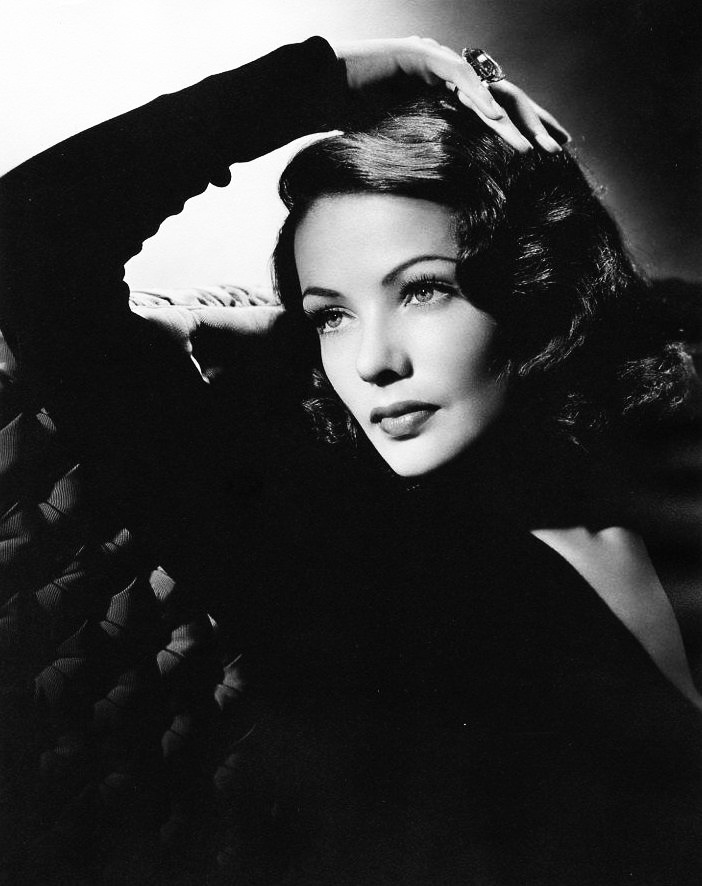
Showing posts with label Gene Tierney. Show all posts

Noirvember Fatale Attractions: Gene Tierney in Laura (1944) and Rita Hayworth in Gilda (1946) 💋


To wrap up my Fatale Attractions series for Noirvember, I want to end with two of the most iconic film noirs that carry women’s names right in the title and yet, the women themselves aren’t true femme fatales at all. Gene Tierney in Laura (1944) and Rita Hayworth in Gilda (1946).

They are often grouped with Stanwyck's Phyllis Dietrichson or Greer's Kathie Moffat, but they aren’t killers, manipulators, or schemers. Instead, they are misunderstood, misjudged, and turned into “dangerous” women simply because the men in their stories fail to see them clearly.


 "No man is ever going to hurt me again. No one. Not even you."


Gene Tierney’s Laura is one of the great mysteries of noir, but the “danger” around her never comes from her, it comes from the men who obsess over her. She’s a smart, successful ad executive who becomes the center of a murder investigation, and every man in her orbit sees a different version of her: Detective McPherson’s (Dana Andrews) ideal woman, Waldo Lydecker’s (Clifton Webb) prized possession, Shelby Carpenter’s (Vincent Price) fantasy and trophy. 


The twist lands, but the real point is simple: Laura never manipulates anyone. She just exists, and the men create their own illusions of who they think she is. 


Laura’s portrait literally becomes an object of obsession, a perfect metaphor for the male gaze.

Tierney always said Laura was one of her most delicate roles because she had to carry the whole film without ever playing the stereotypical “noir woman.” She was the dream, the ideal and that’s exactly what made her a target.


💋💋💋💋💋💋💋💋💋💋💋💋💋💋💋💋💋💋💋💋💋💋💋💋💋💋💋💋💋💋💋💋💋💋💋💋💋


"Sure. I'm decent."

 
Rita Hayworth’s Gilda is one of the most misread women in film noir. The marketing sold her as a dangerous heartbreaker (“There NEVER was a woman like Gilda!”), but the character herself is hurt, emotional, and constantly backed into corners by two men projecting their insecurities onto her. She walks into that smoky nightclub and immediately becomes the woman everyone thinks is trouble, even though she isn’t plotting anything. 


She’s trapped between a jealous husband (George Macready) and a bitter ex-lover (Glenn Ford) who punishes her simply for being desirable. Her “Put the Blame on Mame” number says it all, everyone blames her for things she never did.


Hayworth famously said, “Every man I knew fell in love with Gilda and woke up with me.” That line pretty much sums up why Gilda gets the femme fatale label, she became an image, not a person.


Why do these two stand apart from the classic femme fatales?
Most femme fatales actively manipulate the world around them, think Barbara Stanwyck in Double Indemnity, Jane Greer in Out of the Past, or Lizabeth Scott in half her filmography. But Laura and Gilda are different. They don’t set traps or plot anyone’s downfall. The chaos comes from the men who spiral, misunderstand, and project their own fantasies onto them. Unlike the women who pull the strings, Laura and Gilda never control anything; the illusion of danger is created entirely by the men around them. Their power is accidental and that’s exactly what makes them so fascinating.

Their power comes from presence, not deception. Their “fatality” is manufactured by everyone else.

Both films became pillars of noir. Laura gave us one of the greatest murder-mystery twists of the 1940s and cemented Tierney as a timeless screen presence. Gilda became a global phenomenon, that hair flip alone could’ve fueled an entire studio.

And yet, what I love most is that decades later, we’re still debating whether they count as femme fatales. That tells you how complicated and layered noir women really are.

So to wrap up my Fatale Attractions series, here’s to all the femme fatales, the true ones and the mislabeled ones. The schemers, the survivors, the misunderstood, the mythologized. Film noir never gave us simple “good” or “bad” women; it gave us complicated, powerful, unforgettable ones.

Next year, I’ll be back with even more dangerous women and I’ll be rolling out Noir’s Darkest Minds: The Psychopath Edition for Noirvember.
I just love film noir that much...it always pulls me right back in.

Until then, keep the tension thick, and I'll save you a seat in the dark.

Noirvember Fatale Attractions: Gene Tierney in Leave Her to Heaven (1945) 💋

She’s beauty in broad daylight, no shadows, no smoky alleys, yet she’s as deadly as any noir dame to ever strike a match.
 
 
Elegant, radiant, and terrifyingly controlled, Gene Tierney in Leave Her to Heaven (1945) delivers one of the most chilling performances in film noir. Her beauty is breathtaking, her composure absolute, and her love, lethal.


Directed by John M. Stahl, this Technicolor noir follows Ellen Berent (Tierney), a glamorous socialite who falls hard for writer Richard Harland (Cornel Wilde). What begins as a passionate romance quickly unravels into obsession. Ellen’s love isn’t tender; it’s possessive, consuming, and built on the need to own, not share.

“I’ll never let you go — never, never, never.”

That one line tells you everything. Ellen’s not the usual femme fatale who seduces for money or escape; she’s something rarer and far scarier. Her danger lies in her devotion. Tierney plays her with icy calm and heartbreaking sincerity, never raising her voice, but making you feel the chill beneath every smile.


It’s not a promise. It’s a threat. Ellen isn’t a femme fatale who lures men to crime; she is the crime. Her beauty blinds everyone around her, even as her jealousy corrodes every ounce of tenderness. When she feels Richard slipping away, her possessiveness curdles into something unspeakable, a scene on a lake that remains one of the most disturbing moments in 1940s cinema.

Tierney’s performance earned her an Academy Award nomination, and for good reason: her Ellen is both angel and monster, framed in color so vivid it dares you to look away. Supporting her are Jeanne Crain as the gentle sister she envies, Vincent Price as the scorned ex-fiancé, and Darryl F. Zanuck producing with his usual studio polish.


Leave Her to Heaven broke all the usual rules of noir, proving that evil doesn’t always hide in the shadows. Sometimes, it sits quietly in a boat on a sunlit lake while the world around it struggles and drowns.


Though shot in lush, sun-drenched color, Leave Her to Heaven is pure noir at its core, jealousy, control, and the dark side of desire beneath picture-perfect beauty. Leon Shamroy’s Oscar-winning cinematography turns every frame into a dream that’s just about to curdle.


This was Gene Tierney’s only Oscar nomination for Best Actress. Director John M. Stahl urged her to underplay every emotion, creating that unforgettable stillness that makes her so haunting. Offscreen, Tierney was known for her warmth and humor, which only deepens the chill of Ellen Berent’s icy precision.


Ellen doesn’t lure men into ruin; she loves them there.
She’s not driven by greed or the need to escape. She’s destroyed by the one thing she can’t control... love itself.


Fade to black… until the next Fatale Attraction. 🖤  

🌟Classic Off-Screen Quotes: Gene Tierney

 "Everyone should see Hollywood once, I think, through the eyes of a teenage girl who has just passed a screen test"