"In this world, you must be oh so smart, or oh so pleasant. Well, for years I was smart. I recommend pleasant. You may quote me."
(James Stewart as Elwood P. Dowd)
Let's talk about a film that has always left me feeling all fuzzy and warm inside. Harvey, a marvelous comedy-drama film from 1950 directed by Henry Koster and starring the amazing James Stewart. This gem of a movie is actually based on a Pulitzer Prize-winning play called "Harvey," written by the talented Mary Chase in 1945. It follows the captivating story of Elwood P. Dowd, a genuinely kind and amiable man who lacks any hidden motives or ulterior agenda. He simply lives in the moment, enjoying the occasional drink and spreading joy in the lives of those around him. He is accompanied by his best friend, Harvey. Harvey is a puca, a benign but mischievous creature from Celtic mythology. Harvey is 6 ft 3 1⁄2 in tall, white and, wait for it... invisible rabbit! Yup, you read that right!

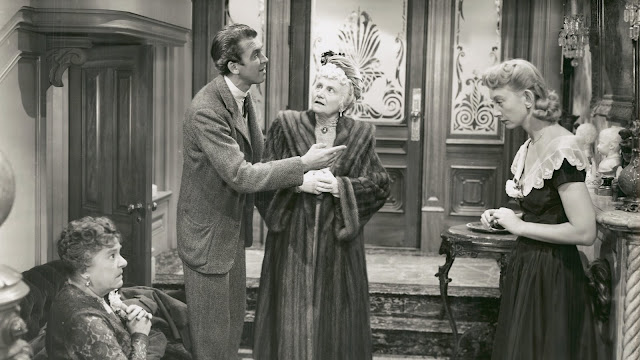
Josephine Hull, plays Stewart's dithery sister for which she won a Best Supporting Actress Oscar. She was best known at the time for having played one of the similarly dithery aunts in both the stage and film versions of Arsenic and Old Lace.
Together
with Victoria Horne, who portrays his niece, they consider themselves
as socialites and come up with a scheme to have dear Elwood sent to a
mental institution.
Together with Victoria Horne, who portrays his niece, they consider themselves as socialites who are embarrassed by Elwood's relationship with Harvey. They view him as a bit of a nuisance and want him out of their lives. They come up with a scheme to send him to a mental institution.
The
two remaining main characters, portrayed by Charles Drake and Peggy
Dow, deliver wonderful performances. Charles Drake plays the role of the
doctor at the sanitorium, blissfully unaware of his nurse's affection
for him. Peggy Dow's portrayal of the lovestruck nurse is exceptional.
The two remaining main characters, portrayed by Charles Drake and Peggy Dow, deliver wonderful performances. Drake plays the role of the doctor at the sanitarium, blissfully unaware of his nurse's affection for him. Dow's portrayal of the love struck nurse is exceptional. There are also some great performances such as Cecil Kellaway and Jesse White. The film takes place over the course of just one day, and in that time, we get to witness Elwood leaving everyone he meets completely charmed and bewildered. From nurses to barflies to taxi drivers, Elwood is a genuinely kind and amiable man who lacks any hidden motives or ulterior agenda. He simply lives in the moment, enjoying the occasional drink and spreading joy in the lives of those around him. He is accompanied by the charming Harvey the rabbit, who adds a touch of whimsy to their adventures.


Together
with Victoria Horne, who portrays his niece, they consider themselves
as socialites and come up with a scheme to have dear Elwood sent to a
mental institution.
Together
with Victoria Horne, who portrays his niece, they consider themselves
as socialites and come up with a scheme to have dear Elwood sent to a
mental institution.The two other leads, played by Charles Drake and Peggy Dow, are great as well. There are also some great performances such as Cecil Kellaway and Jesse White. The film takes place over the course of just one day, and in that time, we get to witness Elwood leaving everyone he meets completely charmed and bewildered. From nurses to barflies to taxi drivers. Elwood is a genuinely kind and amiable man who lacks any hidden motives or ulterior agenda. He simply lives in the moment, enjoying the occasional drink and spreading joy in the lives of those around him. He is accompanied by the charming Harvey the rabbit, who adds a touch of whimsy to their adventures.
Among those considered for the role of Elwood were Bing Crosby, Cary Grant, Rudy Vallee, Joe E. Brown (who had also played the part on stage), Gary Cooper, Jack Benny, Jack Haley and James Cagney.
In both play and TV versions, Stewart absolutely nailed his role in Harvey. His performance is like sipping on a sweet elixir, second only to his outstanding role in "It's a Wonderful Life". We witness a surprising departure from Stewart's trademark frantic or aw-shucks characters, as he dons a refreshing whisper-like demeanor. With a poise that rivals a yoga master amidst a circus of chaos, he commands our attention with every word that escapes his lips.., it's no surprise that folks couldn't resist yearning for more of Stewart as this marvelous character.


Despite his actual height of 6'4'', Stewart refers to Harvey as being 6'3 1/2'' tall and consistently looks up at him throughout the film. Interestingly, this claimed height matches exactly with how Harvey was originally depicted in the play written by Mary Chase. However, during an interview in 1990, Stewart revealed that he had personally decided Harvey should be 6'8'' in the film, allowing him to genuinely look up to the character. Unfortunately, the script for the play wasn't modified to reflect this change.
Harvey performed decently at the box office but didn't quite manage to cover its production expenses. The costs were pushed up significantly by the hefty one million dollar price paid for the rights to the play. Stewart took a percentage of the profits. In 1953, William Goetz estimated that Stewart had earned $200,000 from the film which is equivalent to $2.5 million today.
The central focus of the movie is to advocate for kindness and positivity. One of my favorite scenes takes place in an alley where Stewart, shares a beautiful story about how he met Harvey to Drake and Dow. It is their intention to bring him to the asylum and administer a serum that will help him perceive reality as it truly is. Despite their actions, these characters aren't evil. In fact, they actually feel sympathy for him because they've witnessed his gentle and pleasant nature. However, with their jobs hanging in the balance, they find themselves with limited choices. As he remains seated against a brick wall, he has nowhere to go. Yet, his surroundings suggest he is triumphing over reality. On his right, there's a worn-out stairway with a crumbling brick wall behind it. The gate's shadows cast uneven lines on the wall, symbolizing conflict – that's the real world. On the other hand, he is immersed in pure, untarnished light from the bar he cherishes, accompanied by faint but joyful music. This indicates that he is pure-hearted, free from inner turmoil, and fully aware of his identity and the situation. Perhaps, this implies he may not need the serum after all.

This scene got my tears flowing. It wasn't because of any intense drama or overly sentimental plot, but simply because of the peaceful atmosphere created by a man narrating a heartfelt story to a pair of strangers. The film aims to make us rethink our understanding of sanity. It prompts us to ponder our own values and what really matters to us. Some may view him as a bit eccentric, but deep down he's content with his life. And you know what? That contentment fuels his ability to shower kindness onto others.
 |
| Jimmy Stewart at the premiere of “Harvey” in London, 1950 |
Elwood’s mantras are numerous, all focused on the core principle of being kind and pleasant to one another. While some might argue that he occasionally falls victim to exploitation, it is vital to note that he is not oblivious to this fact. He consciously chooses to rise above such negativity. He possesses intelligence and sanity; he is far from foolish or irrational. If someone displays meanness towards him, it reflects on their character and not his own. When it comes to Stewart's portrayal of Elwood, it's one of those beautiful combinations where the role and the actor seem perfectly tailored to each other.

Director Henry Koster has crafted a truly remarkable piece of cinema that cleverly camouflages a politically "subversive" message within a whimsical and dreamlike fairy tale. Surprisingly, the film challenges the conventional boundaries between sanity and madness, suggesting that the line separating the two is flimsy and uncertain. Moreover, it unabashedly champions the freedom of thought embodied by the endearing Elwood P. Dowd, elevating it above the suffocating confines of societal norms. Throughout the movie, Koster and Chase consistently emphasize the protagonist's unconventional yet refreshing approach to life, even when under the influence. Their intention seems to be to underscore the immense value of embracing diversity within a conservative society like America during that era.
Twenty years after the film's release, Stewart played the role of Elwood once again in a triumphant Broadway revival of Harvey in 1970. This time, Helen Hayes played his sister. Stewart and Hayes reprised their roles for a Hallmark Hall of Fame television production, Harvey (1972). Stewart reprised the role for the final time in a 1975 stage revival in London.

The Jimmy Stewart Museum, based in Stewart's hometown of Indiana, Pennsylvania, presents the Harvey Award to a distinguished celebrity tied to Stewart's spirit of humanitarianism.
As of today, the actors from the main cast who are still living are Peggy Dow and, of course, Harvey. 😉
So, if you're up for a good laugh and a heartwarming tale with a sprinkle of whimsy, "Harvey" is definitely a film you won't want to miss. It's a delightful tale that will leave you smiling and believing in the magic of unexpected friendships.


