Showing posts with label John Payne. Show all posts

🎥 Review: Sun Valley Serenade (1941)

Before I dive into this movie review, I should mention that I haven't seen all of Sonja Henie's films. In a previous post, I talked about Olympic stars who leaped acting, and Sonja was one of them. She was a major star for 20th Century Fox and appeared in many films, much like Esther Williams did for her studio, but I haven't had the chance to explore her entire filmography. 


What I do remember clearly is the fun, snowy setting, the enchanting singing, the ice skating, the dancing, and the exciting skiing in the 1941 production of Sun Valley Serenade by 20th Century Fox. 

My appreciation for Glenn Miller's music grew when I watched this film on American Movie Classics, hosted by Nick Clooney. Out of the two movies featuring Glenn Miller and his Orchestra, the other being Orchestra Wives, Sun Valley Serenade is my favorite!


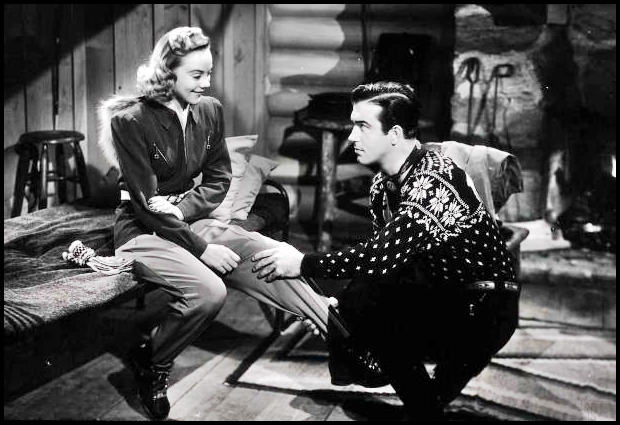
Directed by H. Bruce Humberstone, this romantic musical comedy stars Sonja Henie, John Payne, Glenn Miller (making his debut film appearance after signing with 20th Century Fox), Milton Berle and Joan Davis for some comic relief, and Lynn Bari. It features  Miller's Orchestra with Tex Beneke, Paula Kelly, and the Modernaires as vocalists. 


Milton Berle and Joan Davis


The Nicholas Brothers and Dorothy Dandridge's rendition of "Chattanooga Choo Choo," which was nominated for an Oscar for Best Song, inducted into the Grammy Hall of Fame in 1996, and awarded the first Gold Record for selling 1.2 million copies, is wonderful to watch. 


The plot may seem a bit absurd, but that doesn’t take away from the fun. To sum it up: Daryl Zanuck’s trips to Sun Valley, Idaho, inspired this film. Ted Scott (John Payne), a pianist in a swing orchestra, takes the advice of his manager Nifty Allen (Milton Berle) and decides to adopt an orphan girl from Nazi-occupied Norway. To their surprise, the "girl" is actually the grown-up Karen Benson (Sonja Henie). It’s love at first sight, and she follows him to their Christmas performance in Sun Valley, eager to win his heart, even though he has a girlfriend, Vivian Dawn (Lynn Bari), who is a soloist with Miller's band. 


John Payne and Lynn Bari

In addition to "Chattanooga Choo Choo," other Glenn Miller songs featured in the film include "Moonlight Serenade," "It Happened in Sun Valley," "I Know Why (And So Do You)," and "In the Mood."
 

Sun Valley Serenade was only the second John Payne film I had watched, the first being the cherished Christmas classic Miracle on 34th Street. And yes, I had a crush on him—he looked handsome at the piano and in those cozy winter sweaters!

While the Christmas setting is present, it isn’t overly emphasized. The breathtaking scenes of skiing, skating, and outdoor fun create an authentic and magical atmosphere in the winter landscape.

The blend of comedy, romance, and music is just right.  The romantic chase on the snowy slopes of Sun Valley, filmed on location, adds to the charm, with skiing subtly representing emotional connections, as both Ted and Karen share a love for the sport, unlike Vivian.


The music truly shines, particularly the track "I Know Why." While “At Last” was originally intended for a live performance, it ended up being used as background music and later appeared in Orchestra Wives (1942). 

Sun Valley's ski school director Otto Lang, celebrated for his award-winning shorts and successful features at Fox, directed the ski sequences, with Olympic champion Gretchen Fraser substituting for Henie during the longer shots. 


Jealous of Karen and Ted’s developing romance, Vivian quits in a fit of anger. Henie then puts on a spectacular ice show as a replacement, captivating the audience at the Sun Valley resort hotel. 

The finale, featuring stunning ice-skating scenes, was filmed both on location in Sun Valley and on a chilly soundstage in LA, achieving a remarkable reflective effect in black and white thanks to treated black ink on the ice.


Today, the film continues to enchant audiences at the Sun Valley Resort’s opera house, playing around the clock in lodge hotel rooms, highlighting the lasting appeal of this snowy musical delight!


🎥 Review: The Crooked Way (1949)

In the heart of the city, where shadows whisper secrets and light unravels truths, The Crooked Way from 1949, unfolds like a puzzle waiting to be solved. Actor John Payne steps into the shoes of a man lost in a fog of forgotten memories, thrust into a world of deception and danger. A protagonist turned reluctant detective, navigating the murky depths of his past with a determination that belies his amnesiac state. Intriguing story right? 


Payne portrays Eddie Rice, a man recently discharged from a veteran's hospital after having a piece of shrapnel removed from his brain—and with it, his memories. He returns to Los Angeles to uncover who he was before his military service. It turns out he had a life as a gangster. Upon stepping out of the train station, he's arrested by the police for being someone previously warned to steer clear of the city. A woman on the street identifies him as her ex-husband and makes it clear that she despises him. Additionally, a gang leader gives him a severe beating due to an old betrayal. Welcome back, Eddie. 
 
The cast includes the softly photographed Ellen Drew, who was discovered by actor William Demarest and changed her name from Terry Ray after appearing in 25 films; the intimidating Sonny Tufts, referred to as "The Find of 1943," who gained recognition for his performances in So Proudly We Hail (1943) and the cult classic Cat-Women of the Moon (1953); and the humorous Percy Helton, who depicted the tipsy Santa Claus in Miracle on 34th Street (1947). They both appeared in that movie, though not together.


Musical comedy star turned tough guy actor Payne appeared in a few film noirs. The Crooked Way is his second noir role, but he isn't quite rough around the edges yet. His performance lacks depth here. He later excels in noirs like Kansas City Confidential (1953) and 99 River Street (1952).


The film's plot, reminiscent of the 1946 amnesia noir Somewhere in the Night, is decent. However, it stands out due to its stunning visuals, thanks to cinematographer John Alton.
 
 
Cinematographer John Alton

Alton was responsible for the camera work on numerous classic film noirs during the golden age of cinema. His role in An American in Paris (1951) earned him an Academy Award for best cinematography. If you're familiar with An American in Paris, you’ll notice his exceptional talent in employing color. Through his skillful manipulation of chiaroscuro, he orchestrates light and shadow to heighten the dramatic intensity. Chiaroscuro, an Italian term meaning ‘light-dark,’ is a visual technique that originated with Baroque artists. This method involved studio lighting that cast stark shadows, defining shapes and forms. 


Eventually, this technique transitioned into photography and made its way into films as well. In many ways, the use of chiaroscuro in film noir was essential. Given that these films often operated within tight budgets and limited options for opulent sets, lighting specific
areas of a scene allowed filmmakers to save costs. Additionally, using less expensive sets designed to be obscured by darkness and only partially illuminated as necessary was a practical approach.
Director Richard Florey (Frankenstein's initial director) excelled at creating fast-paced films with a cynical tone and dramatic lighting. His background in expressionism and surrealism perfectly enhances Alton's work.
Both create a narrative that enhances its lackluster storyline, while also exploring profound themes of identity and memory. It's a visual feast that's definitely worth a watch if you haven't seen it yet.


If you're interested in watching more of Alton's film noir creations, be sure to check out these movies:
He Walked by Night (1948), The Amazing Mr. X (1948), Raw Deal (1948), and The Big Combo (1955).