Being
a die-hard fan of classic films, I naturally make connections to
classic Hollywood and its stars whenever I can. I am a passionate
follower of the Olympics, and witnessing athletes compete in a friendly
spirit at this year's Paris 2024 Games, has been truly exhilarating.
Naturally, my mind wandered to the classic actors and actresses who
either participated in the Olympics or came close to doing so.

Before we dive into things, let's take a moment to appreciate and remember one of my all-time favorite silver screen stars, Esther Williams. She would have been turning 102 today. Before making a splash in Hollywood as an actress, swimwear designer, and businesswoman, Williams was a teenage swimming sensation. She won three US national championships in breaststroke and freestyle, setting a record for the 100-meter breaststroke in 1939. She also claimed national titles in Seattle, Washington, and Miami, Florida. Amazingly, she earned a spot on the 1940 U.S. Olympic team, only for the games to be canceled due to the outbreak of World War II. Williams had her sights set on competing in the 1940 Summer Olympics, which unfortunately never happened.

"When I first started swimming, not many girls participated in the sport. They either didn’t want to get their hair wet or wanted to go out on Friday nights instead of going to a meet. But as a result of the popularity of the water ballet, pretty girls began to swim"
Esther decided to join Billy Rose's Aquacade, a hit New York swimming musical show that had just expanded to San Francisco alongside Johnny Weissmuller in his San Francisco Aquacade show. Legend has it that Weissmuller himself handpicked Esther from a group of 75 aspiring actresses at the audition. Though she didn't have a good experience around him due to his inappropriate behavior, the talent scouts couldn't help but be drawn to her charm and beauty. After seeing the success of Olympic figure skater Sonja Henie at 20th Century Fox. MGM's head honcho, Louis B. Mayer, wanted a piece of the aquatic action and famously demanded, "Melt the ice, find a swimmer, and make it pretty!" Before she knew it, a pool was being built on an MGM soundstage, and the rest, as they say, is showbiz history. Williams eventually participated in the Olympics. She served as an advisor to the International Olympic Committee at the 1984 Summer Olympics in Los Angeles for the new sport of Synchronized Swimming and also worked as a commentator. Williams passed away at 91.

Did you know that there was another Olympic swimmer who played Tarzan besides Johnny Weissmuller? His name was Clarence "Buster" Crabbe. Before their Hollywood careers, Crabbe and Weissmuller were competitive friends who knew each other well.

Crabbe dedicated his life to promoting physical fitness, hosting televised fitness programs that inspired many. In 1971, at the age of 63, he achieved a remarkable feat by setting a world age group record in the 400m freestyle. Beyond his athletic pursuits, he also had a wide range of business ventures, notably including Buster Crabbe Swim Pools. Buster passed at 75.
I mentioned earlier how Esther Williams was MGM's answer to 20th century Fox's ice skating star Sonja Henie. Sonja Henie, a Norwegian born talent, made her Olympic debut at just 11 years old at the first Olympic Winter Games in Chamonix, France in 1927. She wowed audiences at the 1928 St Moritz Winter Games, winning gold with an impressive six out of seven judges voting in her favor. Henie continued her winning streak in 1932, unanimously taking first place. She quickly rose to fame, drawing such large crowds that police had to be called in to control them in cities as far apart as New York and Prague. At the 1936 Garmisch-Partenkirchen Winter Games, 23-year-old Henie scored her third gold medal. Just a week later, she clinched her tenth consecutive World Championship title, a feat that remains unmatched to this day. Henie's three Olympic gold medals and ten-time consecutive World championship wins are still unmatched by any ladies' singles skater.
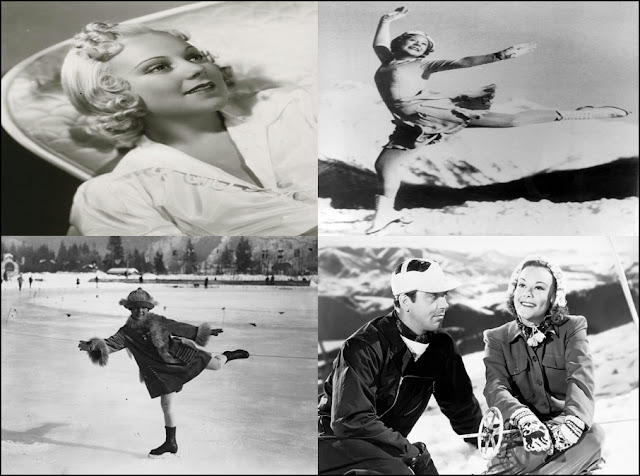
In 1936, after a successful ice show in Los Angeles organized by her father to kickstart her film career, Hollywood studio head Darryl Zanuck offered her a long-term contract at Twentieth Century Fox, making her one of the most highly-paid actresses of the era. Her popular movies included Thin Ice (1937) and Sun Valley Serenade (1941).
By 1938, only Shirley Temple and Clark Gable surpassed her popularity at the box office.
From 1938 to 1951, Henie starred in the annual "Hollywood Ice Review" touring production, which significantly boosted the sport of figure skating.
Henie became a U.S. citizen in 1941 and in 1945, she visited Oslo and performed at U.S. Army hospitals in Europe as a special guest. While she no longer performed, she turned her focus and vast resources towards modern art. In 1968, she established a museum of modern art near Oslo. Henie passed away at 69.
Hey, did you catch that Tarzan yell? Yup, there was another actor who played the iconic role and he was also an Olympian! You might recognize Bruce Bennett from his work in film noir, but did you know he was originally known as Herman Brix? In his earlier years, while majoring in economics at the University of Washington, he was a star athlete. He played football in the 1926 Rose Bowl and was a track-and-field star. He won four consecutive AAU shot put titles (1928–31), the NCAA title in 1927, and the AAU indoor titles in 1930 and 1932. In 1930, he set a world indoor record at 15.61 m (51 ft 3 in). In the 1928 Olympics in Amsterdam, he even broke the world shot-put record on his first toss! Unfortunately, he didn't qualify for the 1932 Los Angeles Games. In 1932, he set his personal best at 16.07 m (52 ft 9 in), but failed at the Olympic trials to qualify for the Los Angeles Games.
 |
|
In 1929, Brix relocated to Los Angeles after receiving an invitation to compete for the Los Angeles Athletic Club. There, he formed a friendship with actor Douglas Fairbanks Jr., who facilitated a screen test for him at Paramount. Although he was a strong contender for the role of Tarzan in MGM's 1932 film "Tarzan the Ape Man," he ultimately lost the part to Mr. Weissmuller due to a shoulder injury. In 1935, Bennett starred in a Tarzan serial titled The New Adventures of Tarzan, which was presented to audiences as either a 12-chapter serial or a seven-reel feature.
In the late 1930s, Brix chose to reinvent himself, moving away from his past as an athlete and the iconic Tarzan, adopting the name Bruce Bennett. He joined Columbia Studios during this period, starting with minor roles and uncredited appearances in comedies such as Blondie Brings Up Baby (1939), The Spook Speaks (1940), and the Three Stooges short No Census, No Feeling (1940). His career quickly took off, leading him to star in a diverse array of films, including westerns and war dramas. Among all the actors who portrayed Tarzan, Bennett enjoyed the longest and most varied career. His transition to Warner Bros. proved advantageous, as he took on the role of Mildred's husband in Mildred Pierce (1945), alongside Joan Crawford. He continued to shine in dramas like A Stolen Life (1946) featuring Bette Davis, and Nora Prentiss (1947) with Ann Sheridan. But his most acclaimed performance came in the adventure film The Treasure of the Sierra Madre (1948) starring Humphrey Bogart. Upon his passing at the age of 100, Bennett requested that memorial contributions be made to the Olympic Committee.Wrapping up our Tarzan ties, let's talk about Josephine McKim, the swimming sensation who dominated the 1928 and 1932 Olympics. In 1928, she snagged the bronze in the 400-meter freestyle and nearly made waves in the 4x100-meter relay before passing the baton to Eleanor Garatti for the final. Fast forward to '32, and McKim struck gold in the 4x100 relay and just missed the podium in the 100-meter freestyle. With five world records under her cap, McKim made quite the splash in the freestyle scene.

She went act as the body double for Maureen O'Sullivan in a deleted nude underwater scene from MGM's adventure film, Tarzan and His Mate (1934), which has been included in home video releases since then. She also had a small role in Universal's Bride of Frankenstein (1935) as a mermaid, one of Dr. Pretorius' "miniaturized" creations. This character was revisited in Columbia's The King Steps Out. Additionally, she shared the screen with her Olympic teammate Buster Crabbe in Lady Be Careful (1936). In 1991, McKim was honored with induction into the International Swimming Hall of Fame. She passed away at the age of 82.
Jim Thorpe was part of the Sac and Fox nation. You may know him as the first Native American to win a gold medal in the Olympics. In college, he played lacrosse, basketball and even won a ballroom dancing championship in 1912. He was in the major leagues from 1913 to 1919, playing for the New York Giants, Cincinnati Reds, and Boston Braves. Then in 1920, he switched to football and joined six teams, including the New York Giants. He was recognized as the greatest athlete in the world during the 1912 Olympics in Stockholm. Thorpe's incredible athletic abilities were showcased through his impressive performance at the Olympics, winning two gold medals where he excelled in various events such as the pentathlon and decathlon. His exceptional skills led him to set a new world record in the decathlon, beating his closest competitor by almost 700 points. Thorpe's record of 8,412 points remained unbroken until 1948.
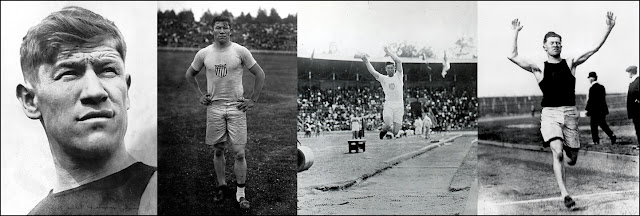
Fun Fact: Just before he was about to compete in the Olympics in 1912, someone swiped his shoes. In a pinch, he grabbed a pair that had been thrown away in a trash can. They were mismatched sizes, so he stuffed extra socks into one shoe to balance things out. Remarkably, he went on to win two gold medals!
He lost his Olympic titles because it was discovered that he had been paid to play two seasons of semi-professional baseball before the Olympics, breaking the amateurism rules of that time. In 1983, 30 years after he passed away, the International Olympic Committee gave him replica medals to restore his Olympic honors. After retiring from professional sports at 41, Thorpe transitioned into the world of acting. He appeared in around 50 films, mostly as an extra, often portraying a Native American in Westerns. His first movie role was in the 1931 serial Battling with Buffalo Bill. In the 1932 comedy Always Kickin', Thorpe had a speaking role as a kicking coach. He also had memorable roles like the captain of the guard in She (1935), an umpire in Knute Rockne, All American (1940), and a member of the Navajo Nation in Wagon Master (1950).
In 1950, he was honored by American sportswriters and broadcasters as the greatest American athlete of the first half of the 20th century, as well as the greatest gridiron football player.
In 1931, he decided to sell the film rights to his life story to MGM. He received $1,500 for it, which today would be equivalent to $30,000! Eventually, Warner Bros. took over the rights and made Jim Thorpe – All-American in 1951, starring Burt Lancaster as Thorpe and directed by Michael Curtiz. Despite rumors that Thorpe didn't get paid, he received $15,000 from Warner Bros. and an additional $2,500 donation towards an annuity for him. The film even featured footage from the 1912 and 1932 Olympics. Thorpe in heart failure, passed away in poverty at the age of 65. He ran out of money because he was always giving to those in need and was often taken advantage of by others. You can visit Thorpe's monument in a town called Jim Thorpe, Pennsylvania.
Some other Olympians went on to become actors on the silver screen...
Nat Pendleton, who made the leap from Olympic wrestler to actor, had quite the journey. While studying at Columbia University, he snagged multiple wrestling titles. He was a two-time champion in the Eastern Intercollegiate Wrestling Association (EIWA) for the 175-pound class in 1914 and 1915, and he graduated in 1916. Pendleton represented the U.S. at the 1920 Olympic Games in Antwerp, Belgium, where he took home a silver medal, losing just one match in a controversial decision. According to the National Wrestling Hall of Fame, he was Iowa's first Olympic medalist.

After his time in the Games, he jumped into the world of professional wrestling and quickly became a crowd favorite, which opened the door to Hollywood. By the mid-1920s, Pendleton was making his mark in films, landing uncredited roles and minor parts. In 1932 alone, he appeared in 17 films, followed by 13 in 1933! He even wrote the screenplay for “Deception” (1932), where he played a wrestler. Over his career, Pendleton was featured in at least 94 short films and features, often getting typecast. Because of his build, he was typically seen as a circus strongman, a tough guy, a dim-witted cop, or a goofy character, but don’t let that fool you—Nat Pendleton was smart. He graduated from Columbia University in 1916 with a degree in economics and was fluent in four languages. He worked with Fox, Warner Bros., and Columbia, but his most notable roles were at MGM, where he starred in classics like The Thin Man (1934) and The Great Ziegfeld (1936), both alongside William Powell and Myrna Loy. He also became a regular in the Dr. Kildare film series during the late 1930s and early 1940s. Pendleton passed away at 72 and was honored with induction into the National Wrestling Hall of Fame in 2004.
Meet Vera Ralston, a Czech figure skater and actress who competed under her given name Věra Hrubá in the 1936 European Figure Skating Championships and with Sonja Henie at the 1936 Winter Olympics in Germany. She placed 15th and 17th respectively. During the 1936 Winter Olympics in Germany, Věra had a memorable encounter with Adolf Hitler. When he asked her if she wanted to "skate for the swastika," she boldly replied, “I’d prefer skating on the swastika itself.” Needless to say, Hitler was not amused.

After fleeing World War II, Věra moved to the United States in 1941 and became a citizen in 1946. She caught the attention of Republic Pictures executive Herbert Yates (her future husband), who saw her potential to follow in Sonja Henie's footsteps.
Věra appeared in Ice Capades and Ice Capades Revue before changing her name to Ralston. In 1943, she signed a contract with Republic Pictures, starting a new chapter in her career in America. Unfortunately, Hruba's grasp of English was so lacking that she had to memorize her lines phonetically. Despite her efforts to improve her English and acting skills, her wooden performances and heavy accent made it tough for audiences to warm up to her.
Nevertheless, she ended up making a name for herself as a "queen" of Republic Pictures, sharing the screen with the likes of John Wayne in Dakota (1945), Wyoming (1948), The Fighting Kentuckian (1951), and Fair Wind to Java (1954). She appeared in a total of 27 films before passing away in 2003.

You might not recognize the name Herman Sakata, but you've probably seen him before as the iconic henchman "Oddjob" in the James Bond film Goldfinger (1964). Hailing from Hawaii, Sakata also represented the United States in the 1948 Summer Olympics in London, where he snagged a silver medal for lifting a whopping 380 pounds in the men's lightweight weightlifting category. He then took on the persona of Tosh Togo, stepping into the ring as a professional wrestler from the early 1950s to the early 1960s, where he achieved the title of Canadian Tag Team Champion. Sakata showed up in a bunch of other movies playing similar types of characters and started going by "Oddjob" as sort of a nickname. He even popped up as a guest star on the TV shows like Hawaii Five-O, Gilligan's Island and Police Woman. He passed at 82.
Carol Heiss, a natural on the ice, is yet another Olympian who transitioned into acting. But only for one film. Hailing from Queens, New York, she began her skating journey at the Brooklyn Ice Palace. By the age of 11, she had already clinched the United States novice ladies’ title in 1951. Heiss made her World Championships debut in 1953 at just 13 years old, finishing in fourth place. In 1955, she was the runner-up to Tenley Albright, but from 1956 to 1960, she reigned as World Champion. At the 1956 Olympics in Italy, she earned a silver medal behind Albright, only to triumph over her at the World Championships shortly after. Heiss maintained her winning streak, securing the U.S. title from 1957 to 1960 and the North American title in 1957 and 1959. Between 1957 and 1960, she was a dominant force in women's figure skating, reminiscent of Sonja Henie. During the opening ceremonies at Squaw Valley, she was honored to deliver the athlete's oath.

After the 1956 Winter Olympics, Heiss had the opportunity to go pro and join ice shows, but her mother, Marie Heiss, was very sick with cancer at the time. Before she passed away in October 1956, she asked Carol to win a gold medal for her at the 1960 Winter Olympics in Squaw Valley, California. Carol kept her promise by winning the gold medal with all nine judges placing her in first. She also took the Olympic Oath as the host nation's representative to kick off the 1960 games. After the Olympics, Carol continued her winning streak by taking the top spot at the 1960 World Championships, becoming one of only three women to win five consecutive World Championships. Back in 1953, she made history as the first woman to nail a double Axel jump. Carol also showcased her skills in amateur ice shows and even made an appearance in the film Snow White and the Three Stooges in 1961.
The next big opportunity that came her way was a chance to work with Jane Fonda. But Heiss decided that her priority was building a steady and happy life with her new husband rather than pursuing an acting career. Even the Stooges warned her against getting too caught up in Hollywood if she wanted a 'normal' family. During her time shooting Snow White in Los Angeles, she received a devastating phone call one night. "My brother-in-law called me at 2 am and told me they were all gone." On the morning of February 15, 1961, a tragic plane crash near Brussels took the lives of all passengers on board, including 18 skaters, 6 coaches, and 10 officials and family members who were on their way to the World Championship in Prague.
In the late 1970s, she started coaching several skaters in Lakewood, Ohio. Among her notable former students are Timothy Goebel, Tonia Kwiatkowski, and Miki Ando. Heiss has been honored with induction into both the World Figure Skating Hall of Fame and the United States Figure Skating Hall of Fame.
Mitch Gaylord, a member of the US men's national artistic gymnastics team, was a key player in leading the team to its first-ever gold medal in the 1984 Olympics. He also snagged three individual medals - silver on vault, and bronze on parallel bars and rings. Originally from California, Mitch joined the national team in 1980 and continued to impress until 1984. He even dominated the 1981 Maccabiah Games, winning five gold medals. While studying history at UCLA on scholarship, Mitch achieved incredible success in gymnastics, including winning the All-Around at the USA Gymnastics National Championships and the NCAA Men's Gymnastics Championship in 1984 - where he made history by scoring a perfect 10.00 in the Olympics!

After the 1984 Olympics, he embarked on a six-month promotional tour across the United States with his fellow Olympic gymnasts, which led to sold-out shows in approximately two dozen American cities. During this period, he authored his first book focusing on utilizing gymnastics exercises for training. In November 1985, he was appointed by President Ronald Reagan to serve as a member of the President's Council on Physical Fitness and Sports. He transitioned into acting, notably starring in the gymnastics film American Anthem (1986) alongside Janet Jones and working as a stunt double for Chris O’Donnell in the 1995 movie Batman Forever.
In addition to his acting pursuits, he made frequent appearances on Hollywood Squares and was featured in promotions for various brands such as Diet Coke, Nike, Vidal Sassoon, Soloflex, Levi's, and Texaco. He later transitioned to a career in finance with Morgan Stanley Smith Barney. He was inducted into the UCLA Hall of Fame in 1995, the US Olympic Hall of Fame in 2006, and the International Jewish Sports Hall of Fame in 2009. Furthermore, he took on roles as a journalist and public speaker in his professional endeavors.


%20-%20YouTube%20-%20www.youtube-tile.jpg)
%20-%20Bowling%20With%20Pamela%20Scene%20(8_10)%20-%20Movieclips%20-%20Y_%20-%20www.youtube-tile.jpg)



%20Blu-ray%201080p%20Full%20Movie%20%5BSUB%5D%20-%20YouTube_%20-%20www.youtube-tile.jpg)


%20Movie%20Clip%20-%20YouTube%20-%20www.youtube-tile.jpg)
%20Bowling%20Scene%20-%20YouTube%20-%20www.youtube-vert.jpg)


%20-%20Full%20Movie%20-%20John%20Barrymore,%20Brando_%20-%20www.youtube.com.png)