Noirvember Fatale Attractions: Ava Gardner in The Killers (1946) 💋


She strides into the room dressed in black satin, her eyes shimmering with mischief, and just like that, every man in the story loses track of where he was headed. In The Killers (1946), Ava Gardner introduces us to Kitty Collins.. a femme fatale so captivating and subtly dangerous that you can’t help but see why a man would risk everything for her.


Directed by Robert Siodmak, this film takes its cues from Ernest Hemingway’s short story, weaving between past and present as detectives piece together why ex-boxer “The Swede” (Burt Lancaster, making his film debut) didn’t fight back when two hitmen came for him. The answer, as is often the case in classic noir, begins with a woman. Kitty Collins.


The type of woman who smiles as if she knows you’re not being truthful because she’s already spun a better tale.

“I am poison, for myself as for those around me. I would be afraid to live with a man I love — I would cause him too much harm.”

That line is quintessential Ava. Kitty isn’t loud or theatrical; she’s a slow burn — all silk on the surface and steel underneath. She doesn’t explode; she seeps in. Her danger isn’t in the threats she makes, but in the truths she admits. Kitty knows exactly what she is… and she knows men will still walk straight into her arms anyway.

She doesn’t seduce for kicks; she seduces to survive. She doesn’t bluff; she manipulates with the quiet assurance of someone who’s already strategized five steps ahead.


She doesn’t destroy men with poison...she dismantles them with hope. The Killers marked Ava Gardner’s rise to fame. Before Siodmak chose her for the role of Kitty, she had been drifting through smaller parts, but this decision catapulted her into the spotlight.


Hemingway was said to be quite taken with Ava’s performance, remarking that she perfectly captured Kitty’s “danger and temptation.” The film snagged Oscar nominations for Best Director, Best Editing, and Best Adapted Screenplay pretty impressive for a noir that sprang from a short story that’s barely ten pages long.


Kitty Collins never raises her voice, never hurries, and never apologizes. She allows the Swede to fall slowly, willingly until he’s completely oblivious to the ground beneath him. She doesn’t just break hearts. She examines them, selects them, and walks away with the fragments.

“People have told me through the years that it was The Killers that set me on the road to stardom, that defined my image as the slinky sexpot in the low-cut dress, leaning against a piano and setting the world on fire.”

Fade to black… until the next Fatale Attraction. 🖤

Mary Astor in The Maltese Falcon (1941)


Noirvember Fatale Attractions: Gloria Swanson in Sunset Boulevard (1950) 💋


She isn’t just a femme fatale, she’s a fallen goddess clinging to the spotlight. In Sunset Boulevard (1950), Gloria Swanson gives one of the most haunting performances in film history as Norma Desmond, a silent film star who can’t accept that the cameras stopped rolling long ago.


Directed by Billy Wilder, the film opens with a dead man floating in a swimming pool, screenwriter Joe Gillis (William Holden), and then rewinds to show us how he got there. Broke and cynical, Joe stumbles into Norma’s decaying Hollywood mansion, where time, fame, and sanity have all begun to rot. She hires him to edit her comeback script, but before long, he’s trapped by guilt, by comfort, and by the hypnotic pull of a woman who refuses to fade away.


“I am big. It’s the pictures that got small.”

That line alone immortalized her. Norma isn’t a femme fatale in the traditional sense; she’s not plotting a crime for money or power. Her weapon is illusion. She kills with nostalgia, with the promise of stardom, with the kind of love that demands you never leave the dream. Swanson plays her with terrifying sincerity, part diva, part ghost, all tragedy.


William Holden perfectly balances her grandeur with weary realism, and Erich von Stroheim, as her devoted butler Max, adds another layer of heartbreak to the story. Wilder’s direction turns old Hollywood into a haunted house, the boulevard of broken spotlights and shattered egos. 


The film earned eleven Oscar nominations, winning three, including one for Best Actress for Swanson, whose performance still stands as one of cinema’s most unforgettable.


Swanson really had been one of the silent era’s biggest stars; she was Norma Desmond in more ways than one. Her casting blurred the line between fiction and memory, making the performance almost painfully real.


Norma doesn’t lure men with promises; she traps them in her fantasy. She doesn’t want love. She wants applause.
 
Fade to black… until the next Fatale Attraction. 🖤 
 

Noirvember Fatale Attractions: Lana Turner in The Postman Always Rings Twice (1946) 💋


She walks in wearing white heels, a halter top, and lipstick that could stop traffic and suddenly every man in the diner forgets what he was about to order. In The Postman Always Rings Twice (1946), Lana Turner doesn’t just arrive… she hits the screen like a warning shot.


This is the femme fatale everyone thinks about when they picture classic noir glamour and danger rolled into one.

Based on James M. Cain’s scandalous novel and directed by Tay Garnett, the story centers on Frank Chambers (John Garfield), a drifter who wanders into a roadside café and straight into trouble. Cora Smith is beautiful, trapped in a stale marriage with Nick Smith (Cecil Kellaway), and hungry for escape.


She’s not twisting a mustache or plotting world domination; she’s desperate, and desperation in noir is always explosive. Together, she and Frank make a choice that can only end one way: badly.


"Do you love me so much that nothing else matters?"

Turner plays Cora with that perfect mix of steel and softness, a woman who knows the world hasn’t done her any favors and stops waiting for it to. Unlike the ice-cold Phyllis Dietrichson or the unhinged Ellen Berent, Cora feels human. She’s flawed, frustrated, and ready to burn down the life that’s caged her. That’s what makes her dangerous, not witchcraft or manipulation, but clarity.


The film pushed boundaries with its heat and violence, nudging the Production Code as if daring it to blink. Turner, wrapped in satin and tension, gave the performance of her career. And opposite her, Garfield is all restless energy; together their chemistry could light the whole diner on fire.

MGM actually bought the rights to Cain’s very risqué novel way back in 1934, but the Hays Office shot down every script they tried. It wasn’t until the huge success of Cain’s Double Indemnity (1944) that the studio finally took another swing at it and this time, they got it through.


Director Tay Garnett stated that he commissioned Irene, MGM’s chief costume designer, to create almost all of Lana’s outfits in a pure white hue in order to satisfy the censors.


Turner fought hard for this role; she wanted out of the “glamour girl” box, and she shattered it. She even said Cora was “the role I liked best.” And that all-white entrance outfit? It became one of the most recognizable looks in film noir history: clean on the surface, toxic underneath. Perfect.

Cora isn’t promising love or redemption; she’s offering a way out, whatever the cost. And in noir, that’s enough to doom everyone in her orbit.

Fade to black… until the next Fatale Attraction. 🖤

Gloria Swanson in Sunset Boulevard (1950)  


Noirvember: Interior Motives 🚘

Armored Car Robbery (1950)/The Mob (1951)/Appointment with Danger (1951)/Beyond A Reasonable Doubt (1956)/The Undercover Man (1949)/The Good Die Young (1954)/The Desperate Hours (1955)/A Cry in the Night (1956)/Vice Squad (1953)/Private Hell 36 (1954)/Scandal Sheet (1952)/High Tide (1947)


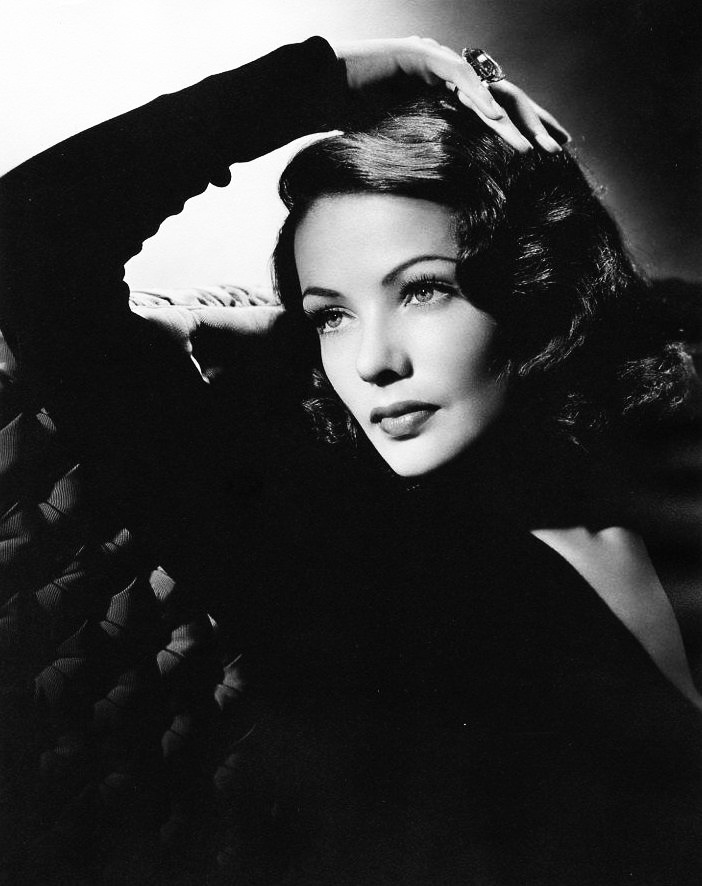
⭐Classic Off-Screen Quotes: Gene Tierney

“I’ve been through hell, and I’m grateful for every minute of it.”

Noirvember Fatale Attractions: Joan Bennett in Scarlet Street (1945) 💋

She purrs his name like it’s a secret — “Johnny…” — and just like that, his world begins to unravel. In Scarlet Street (1945), Joan Bennett sheds her earlier glamour to become Kitty March, one of film noir’s most vicious, irresistible heartbreakers. She’s a femme fatale without the polish, without the satin gloves. Just grit, greed, and a survival instinct sharper than a knife.


Directed by Fritz Lang, this bleak and fatalistic film adapts the French novel La Chienne (meaning “The Bitch”) by Georges de La Fouchardière, a story rooted in betrayal, desire, and moral corruption. It centers on Christopher Cross (Edward G. Robinson), a shy cashier who becomes an aspiring painter. Christopher rescues Kitty from a late-night beating in a rain-soaked New York street, he falls for her instantly. Kitty sees an easy mark. Her boyfriend, played by a deliciously sleazy Dan Duryea, sees dollar signs. Together, they bleed Christopher dry of money, art, and eventually, hope. What begins as a simple con turns into one of noir’s most tragic unravelings.


"He tried to kiss me today. And don't think I liked it."


That line is pure Kitty. She isn’t the cool, calculated ice queen of Double Indemnity. She’s raw, streetwise, messy, and absolutely shameless. Bennett plays her as a woman carved by bad choices and worse men, someone who learned young that manipulation pays better than sincerity. There’s no remorse in Kitty, just appetite. Lang’s direction turns the city into a moral maze, cramped rooms, harsh shadows, and windows that feel like cages.


Lang reunites his Woman in the Window trio (Robinson, Duryea, Bennett), but this time pushes them into even darker territory. Robinson gives one of his most vulnerable performances, Duryea revels in sleaze, and Bennett, with those dark bangs and that sly little smirk, becomes a full-fledged noir goddess.

Scarlet Street was so scandalous for its time. Adultery, murder, and exploitation it was banned in three states (New York, Ohio, and Atlanta). Fritz Lang fought for Joan Bennett to take on Kitty. He wanted her “dangerous,” not dainty. A massive shift from her 1930s ingénue image. She later called Kitty one of her favorite roles because it let her be “wicked, but human.” Bennett and Lang made a creative dream team (and sometimes a nightmare). Lang pushed her relentlessly, demanding harder edges and a colder heart. The result? The best performance of her noir career.


Kitty doesn’t play by noir’s usual rules. She isn’t haunted, conflicted, or tragic — she’s only haunted by what she can’t have. She toys with men because she can, and when the game turns bloody, she doesn’t flinch.

She doesn’t wear her heart on her sleeve…
She sells it, one lie at a time.


Fade to black… until the next Fatale Attraction. 🖤

Lana Turner in The Postman Always Rings Twice (1946)  

Noirvember Fatale Attractions: Claire Trevor in Born to Kill (1947) 💋


Sometimes people don’t fall into darkness; they walk toward it. In Born to Kill (1947), Trevor plays Helen Brent, a woman who can’t seem to resist danger, even when she knows it’ll destroy her.


Directed by Robert Wise, the story follows Helen, a poised divorcée who witnesses a double murder while staying in Reno. Instead of running for her life, she becomes entangled with the killer himself, Sam Wilde, played by the magnetic (and menacing) Lawrence Tierney. He’s all violence and swagger; she’s cool, smart, and drawn to his recklessness like a moth to a flame.


“I hate you so much, I could kill you.”
 
 
That line captures the whole twisted pull between them, attraction and destruction intertwined. What makes Born to Kill so fascinating is that it’s told through Helen’s eyes, a rarity in film noir. That female perspective gives us a more complicated kind of femme fatale, one who isn’t just manipulating men for money or power. Helen is drawn to Sam’s brutality, yet she’s also tempted by Fred’s money and stability. Instead of leading a man into ruin, she’s the one pulled down by her own dangerous desires.


Trevor plays Helen with elegance and emotional honesty; you can feel the tension between what she wants and what she knows she shouldn’t. She’s not heartless, she's human.


The film itself stirred plenty of trouble. Censors in Ohio, Chicago, and Memphis rejected it outright, calling it too immoral for public viewing. Even the National Legion of Decency objected, scandalized by its frank attitude toward divorce, though, fittingly for noir, they couldn’t quite bring themselves to ban it completely.


And its impact still lingers. Director Guillermo del Toro has credited Born to Kill as a major influence on his Nightmare Alley (2021), noting that “a couple of the murders in the movie are shocking, even in 2022.”


Claire Trevor was already Hollywood’s queen of tough women, but this role showed just how layered she could be. A year later, she’d win an Oscar for Key Largo, yet Born to Kill remains one of her boldest, most psychologically daring performances.


Helen doesn’t just flirt with danger; she falls for it completely.
She doesn’t destroy men... she’s destroyed by the man she can’t let go of.
 
Fade to black… until the next Fatale Attraction. 🖤